
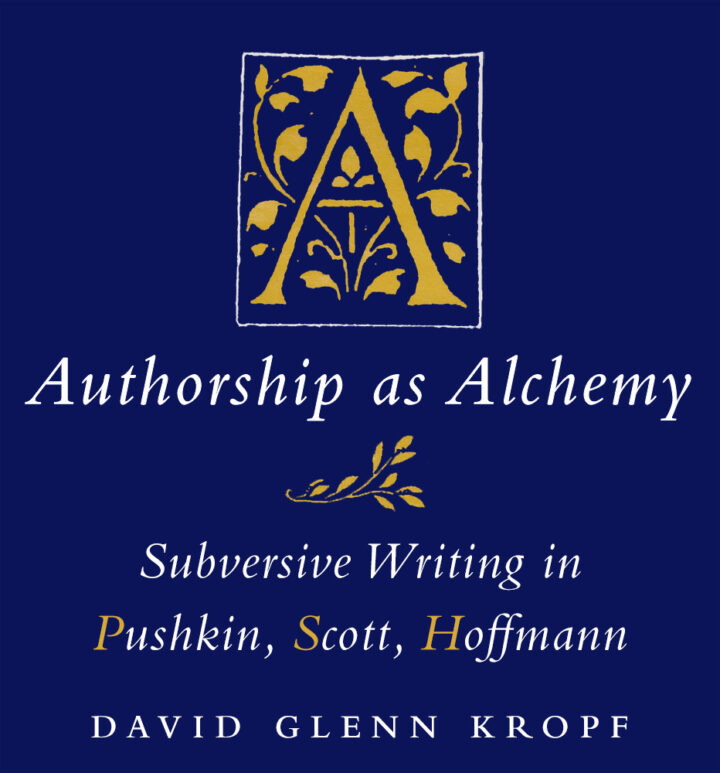
If there is one academic book out there truly inspired by Whitman’s famous “I am large, I contain multitudes,” then this is it: Authorship as Alchemy by David Glenn Kropf. A brutal lit-crit read, but the concept is simple: What if writers (what if each one of us) were not just a mere single person, but multitudes? Not just woman or man — but “pan”?
Authorship as Alchemy explores some of the tricky tactics that writers over the centuries have used to disguise themselves and hide themselves. Writing anonymously or using a pseudonym are the obvious ones, but the implications of this are really massive, especially now in the twenty-first century when many of us are seeking to define our “selves” in ways that are not fixed or that mesh with codified social definitions. Am I the same person I was ten years ago? Look at my passport, and governments will say yes, but what if identity could be conceived as changeable over time. Sexuality, psychology, identity all begin to pluralize The whole project …
consists not in doing away with social subjectification or even the mechanisms of authorship, but rather in subvert their workings on the individual in order to create a space of personal freedom, however small.
At first, some of the concepts seem overly complicated, such as hecceity which Kropf defines as “thisness”: how we are now, who are we now, at this very moment. What Husserl calls a Jetztpunkt (a “now point”) — the real emphasis throughout the book is identity in the now, at a moment. String these moments together and you get what we could loosely call a “self,” and Kropf very much wants to keep the connection loose. The more stringent and binding it is, the more subjectivizing or totalitarian a government is apt to be. Thus, it’s the moment that counts, and that is something that currently receives a great deal of attention in many social spheres. No resting on the past or future, for we can too easily get lost there, but in maximizing out pleasure and our self-realizations at the moment. Other terms that give good leverage:
Rhizome. Like the plants that grow horizontally, underground, Kropf (following the powerhouse work of Deleuze and Guattari in A Thousand Plateaus) like to see each of us as growing outward rather than up. We do not rise, but spread. This puts the emphasis less on power and hierarchy, and more on a plurality of equally empowered humans.
Subversive. Under the verse, under-ground. Picks up on the rhizomatic idea, but gives a punch to ideas flourishing beneath established doctrine.
Alchemy. It’s the lead that counts… the base metals, for these are the source of the gold that is created. But it’s all about mutation, transformation, or Becoming. Ultimately, authorship (the act of writing) and identity (a plurality of being) attain their value as processes.
Things can get tricky in the ethics department (such as holding someone accountable for an action), but draconian governmental enforcement is always tricky. Where are the limits? How far can or should a government go? Kropf seeks to hang out in the gap… the middle zone… what he calls the milieu where plural and singular meet.
Think of a writer or actor who has been typecast. Just mention Grisham or Rowling or Schwarzenegger and we know what we’re in for. But add some alchemy from this book, and the whole powder keg of fixed identity blows up. There are many implications for creators (writers, artists, actors), but also lawmakers who create structures that control, and also every individual who can find ways of busting out of constraining suits of armor.